
Why a painting course should start with your painting
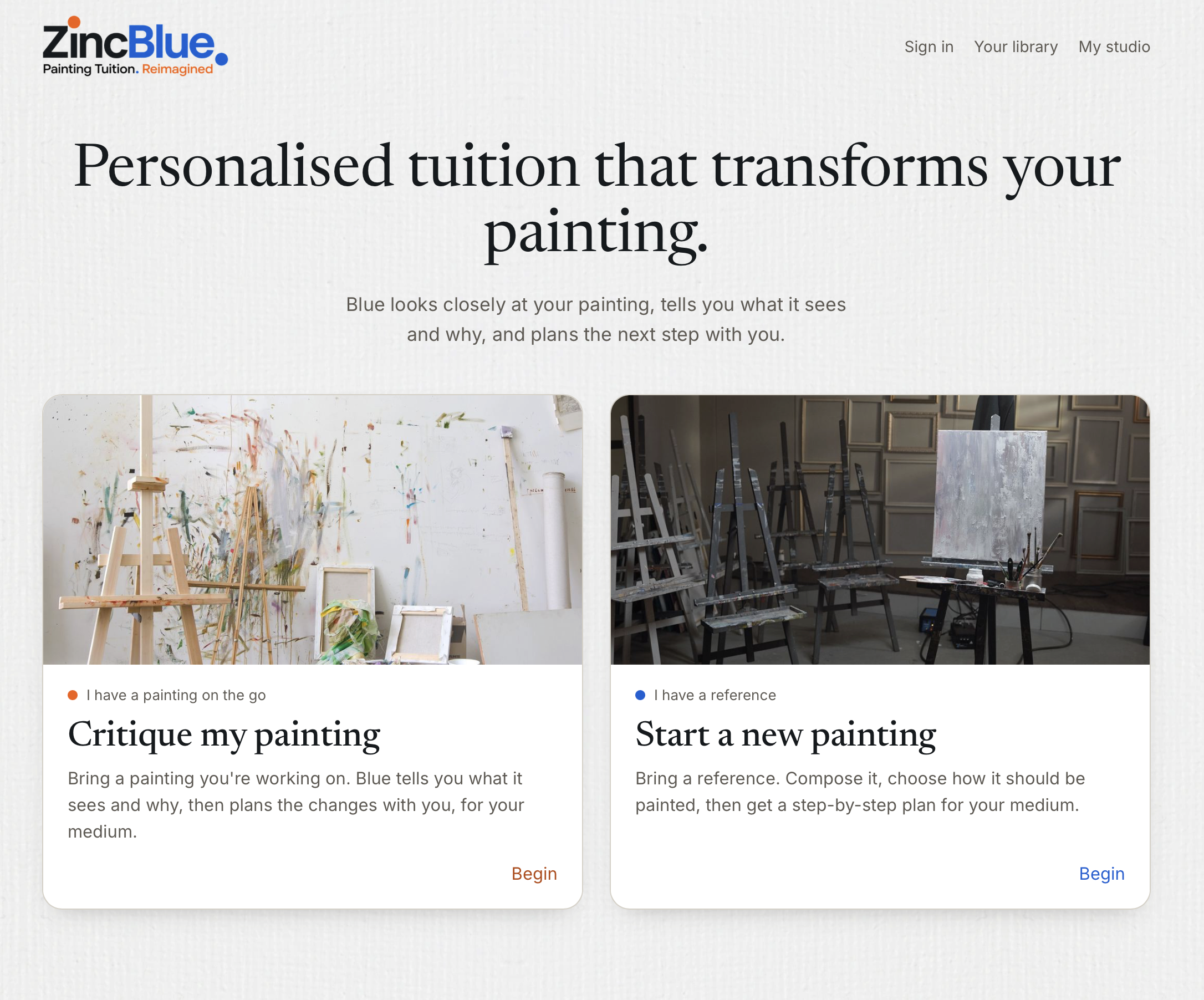
How good is this work? What should I paint ? ZincBlue starts with the questions every painter asks.
Most courses begin with a syllabus, many painters scour the internet to find a suitable help video. ZincBlue begins with the work on your easel, and lets your lesson grow from there.
Most painting courses begin in the same place: with the course. There's a subject to cover, a sequence of exercises, perhaps a demonstration, and a set of ideas to work through. That model can be enormously useful. But by necessity, it's built around what the teacher has decided to teach before they've seen the painting you're actually trying to make.
Painting rarely develops in such a tidy order. One painting suddenly needs better value structure. Another is technically sound but compositionally inert. A third has lost the temperature relationships that made the original idea exciting. Sometimes the problem is colour; sometimes it's drawing, emphasis, edges, saturation, sequence, or simply knowing what to leave alone. And two painters working in completely different styles can run into remarkably similar problems.
Which raises a simple question: what if the course began with the painting instead?
Your painting as syllabus
In more than twenty years of teaching painting, I've found that the most useful conversations rarely begin with a predetermined lesson. They begin by looking.
A student brings a painting into the studio, and we ask what's happening. What's working? Where is the painting becoming uncertain? What relationships are holding it together, and what is competing for attention? What does the painter want it to become?
Only then does the teaching really begin. One painter needs to understand value compression. Another needs a more limited palette. Someone else needs to reorganise the composition before touching the paint again. The lesson emerges from the painting.
That idea became one of the foundations of ZincBlue. Instead of asking you to work through a generic sequence of lessons, it begins with the work you want to make. Your painting, reference, medium and intentions provide the context, and the relevant teaching is assembled around the problem in front of you. In that sense, the painting becomes the course.
Painting problems are contextual
The trouble with generic advice isn't usually that it's wrong. It's that it isn't relevant to the work you are doing.
A painter struggling with colour harmony doesn't need a lecture on perspective at that moment. Someone wrestling with the first block-in doesn't need an advanced discussion of glazing. Good teaching is partly about knowledge, but it's also about timing: the same advice can be transformative at one stage of a painting and a distraction at another.
So ZincBlue works from context. It looks at the painting, the medium, the stage the work has reached and the direction you want to take it, and suggests a route forward. Not because there's one correct answer, but because some decisions are more useful than others at a particular moment.
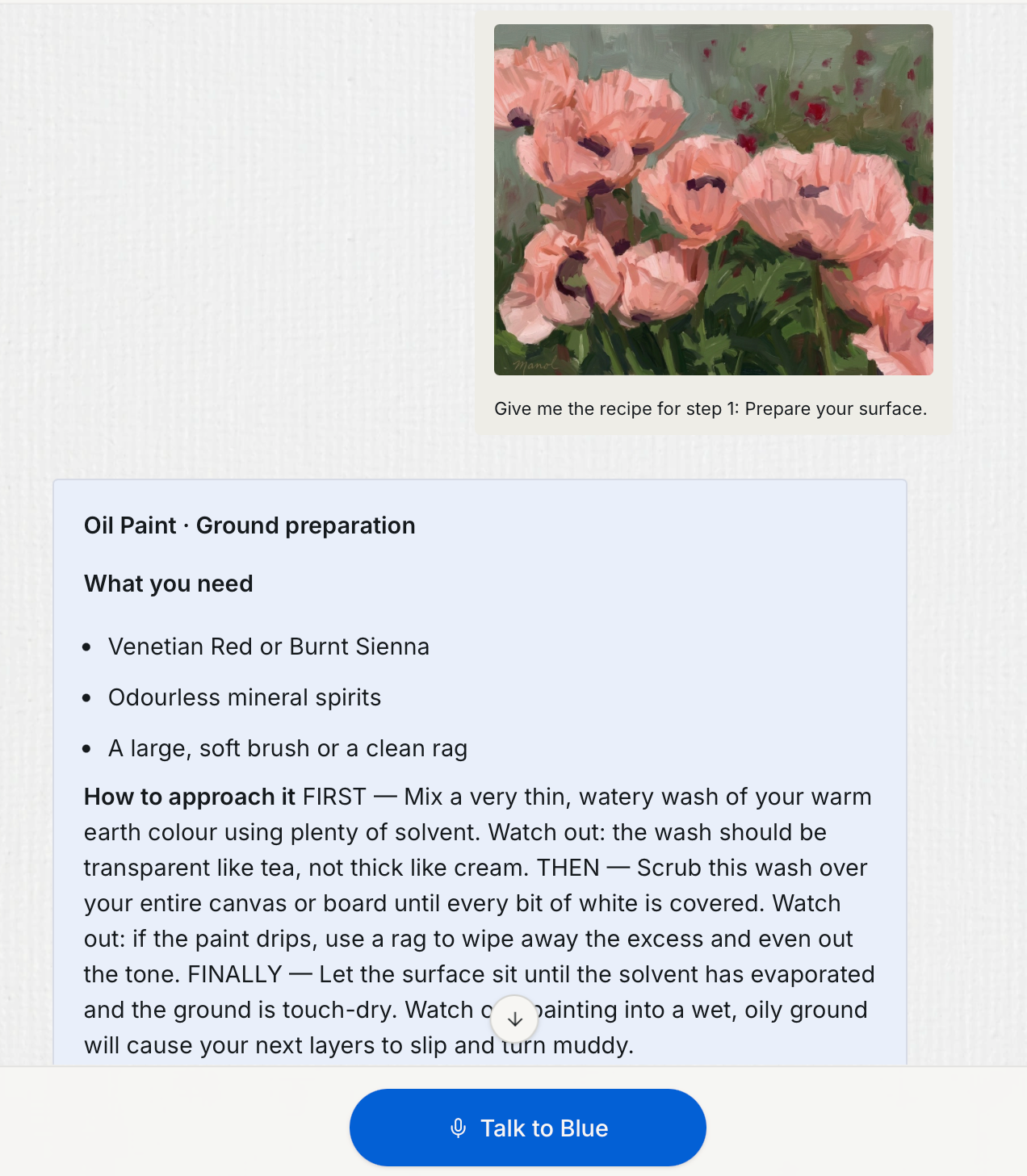
You could scour YouTube for a painter working a bit like you , OR you can get tailored advice on the work you’re actually doing. ZincBlue makes finding the right information easy - and it helps you to put it into practice.
A course that can change direction
Traditional courses move forward in a line. Painting doesn't.
Painters circle back and revise. They discover that a small change has created a new problem somewhere else. They abandon one intention and find another. That isn't failure; it's very often how painting develops. So a course built around the painting has to be able to change direction too.
You might begin with composition, move into value, and then find that the real opportunity lies in temperature or saturation. A colour decision might lead to a new question about emphasis. A comparison with your reference, or with another painting, might expose something you hadn't noticed. The learning path grows with the work.
That's why ZincBlue is built around connected critiques, plans, Labs and conversation rather than a fixed ladder of lessons. The aim isn't simply to deliver information. It's to help you identify what matters next.
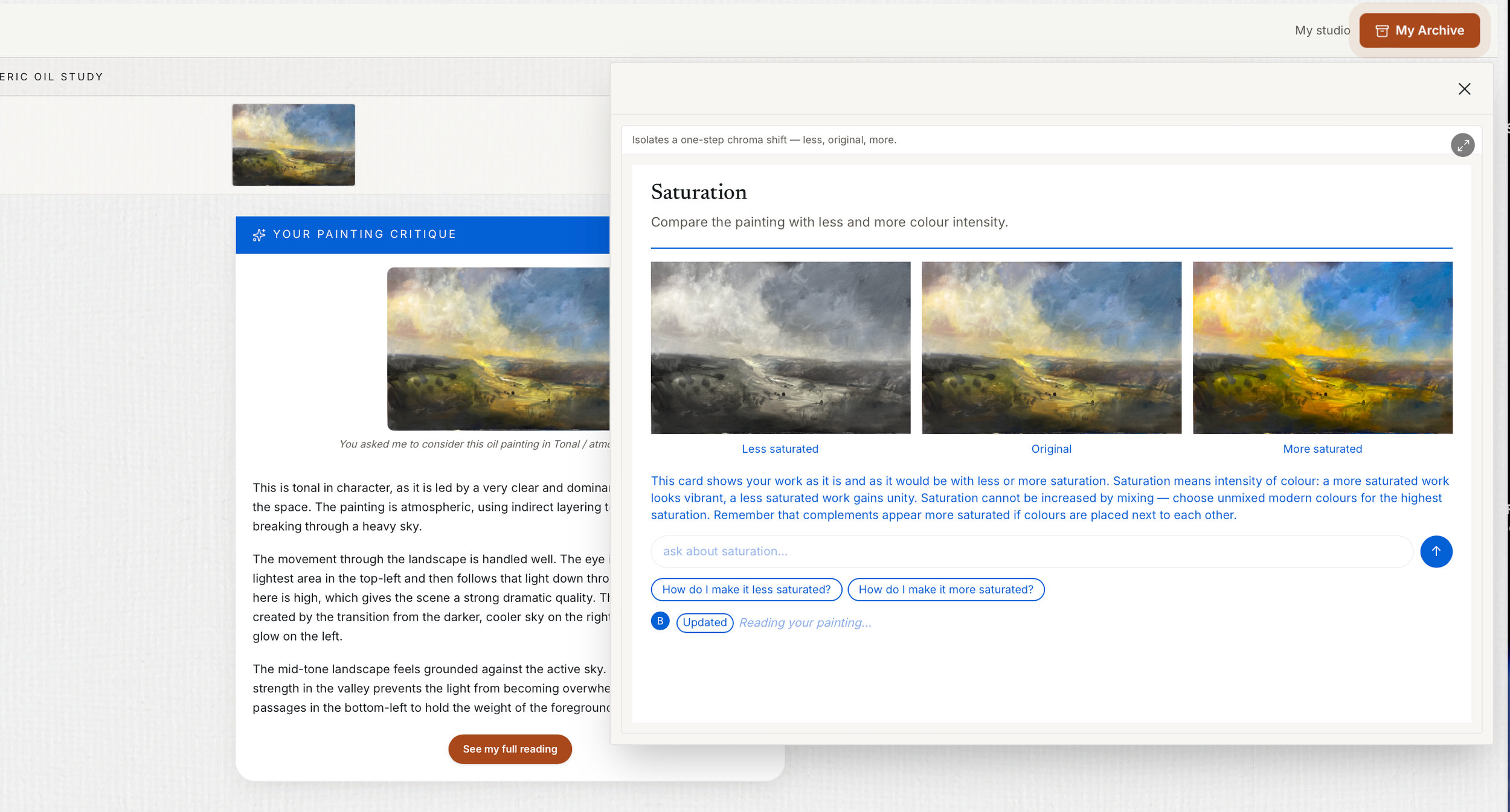
All of these work, and you will pefer the one that works best for you. ZincBlue helps you to see the options and make the changes you prefer.
Teaching without taking over
There's another important distinction. A personalised course shouldn't become a set of instructions telling you exactly what to do. Painting depends on judgement, and if every decision is outsourced, the painting may improve while the painter learns very little.
So ZincBlue is deliberately built to offer possibilities rather than commandments. You might strengthen a value contrast, or soften it. You might suppress one colour relationship to make another more powerful. You might crop aggressively, or keep more of the original space. Each decision has consequences.
The useful question isn't always "What should I do?" More often it's "What happens if I do this?" That shift matters, because the purpose of teaching isn't only to help you make a better painting today. It's to help you make better decisions tomorrow.
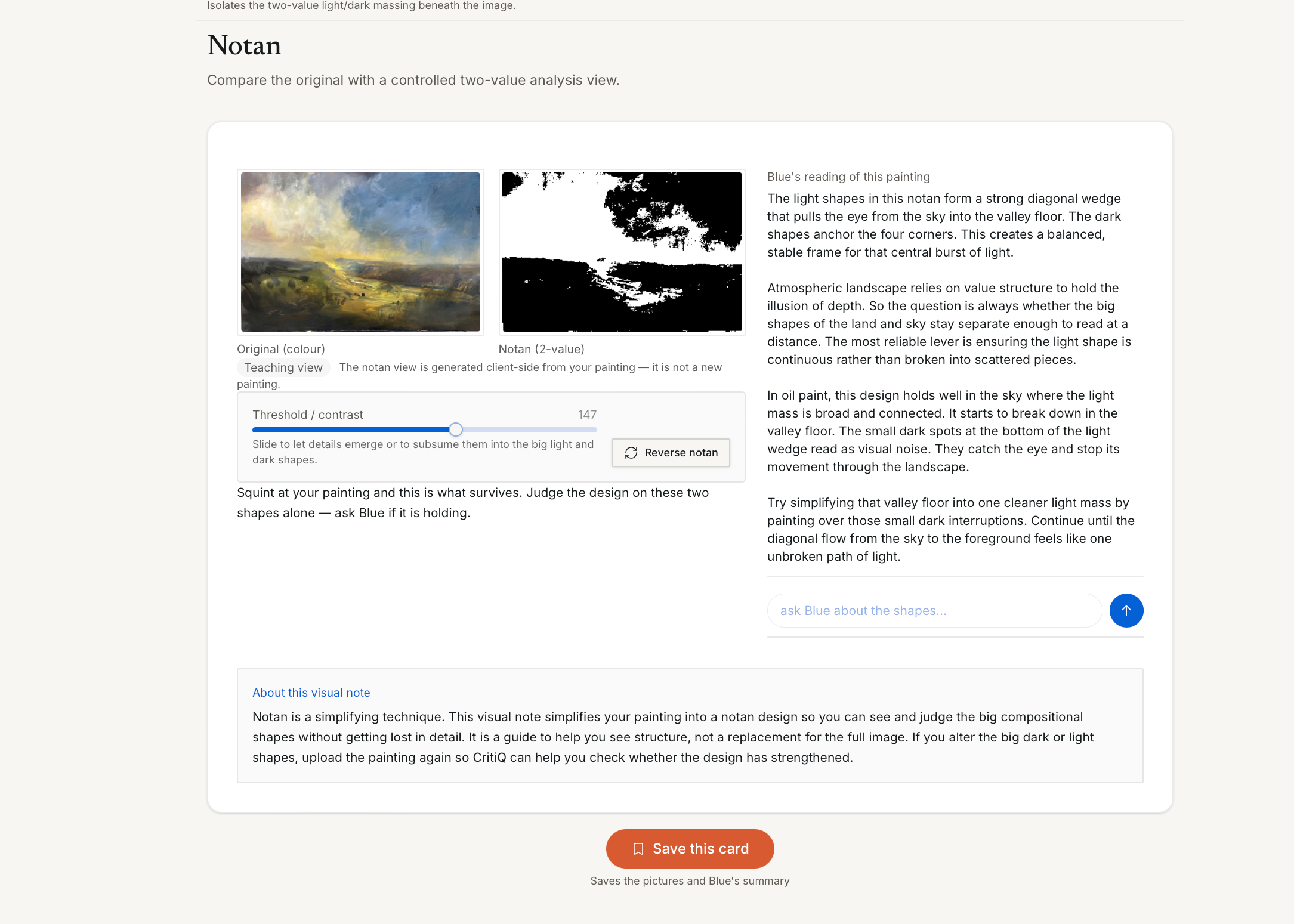
Seeing that it wiorks - and kbnowiung why it works re not the same., ZincBlue teaches you the big ideas which make better paintings as you work.
Built from painting
ZincBlue grew out of years of looking at paintings with painters. Over time, recurring structures become visible. Across very different styles, the same questions keep returning: value, colour, saturation, temperature, emphasis, composition, sequence and handling. The surface changes; the underlying decisions often don't.
That accumulated teaching experience is the basis of the system behind ZincBlue. The technology lets that teaching arrive in a new form, but the principle is surprisingly traditional: look carefully at the painting in front of you, understand what the painter is trying to achieve, and decide what would be most useful to explore next.
Your painting determines the journey
Books, demonstrations, workshops and structured courses will always have value, and ZincBlue isn't meant to replace them. It simply begins somewhere else.
Instead of asking "What lesson should I study today?", it asks "What does this painting need me to understand?" That small reversal changes the relationship between teaching and practice. The curriculum is no longer imposed before the work begins; it emerges from the work itself.
Perhaps that's closer to how painters have always really learned: one painting, one problem and one discovery at a time.
ZincBlue is opening for bespoke Mentoring students soon - join the waitlist here