
Painting Is Circular, so is ZincBlue.
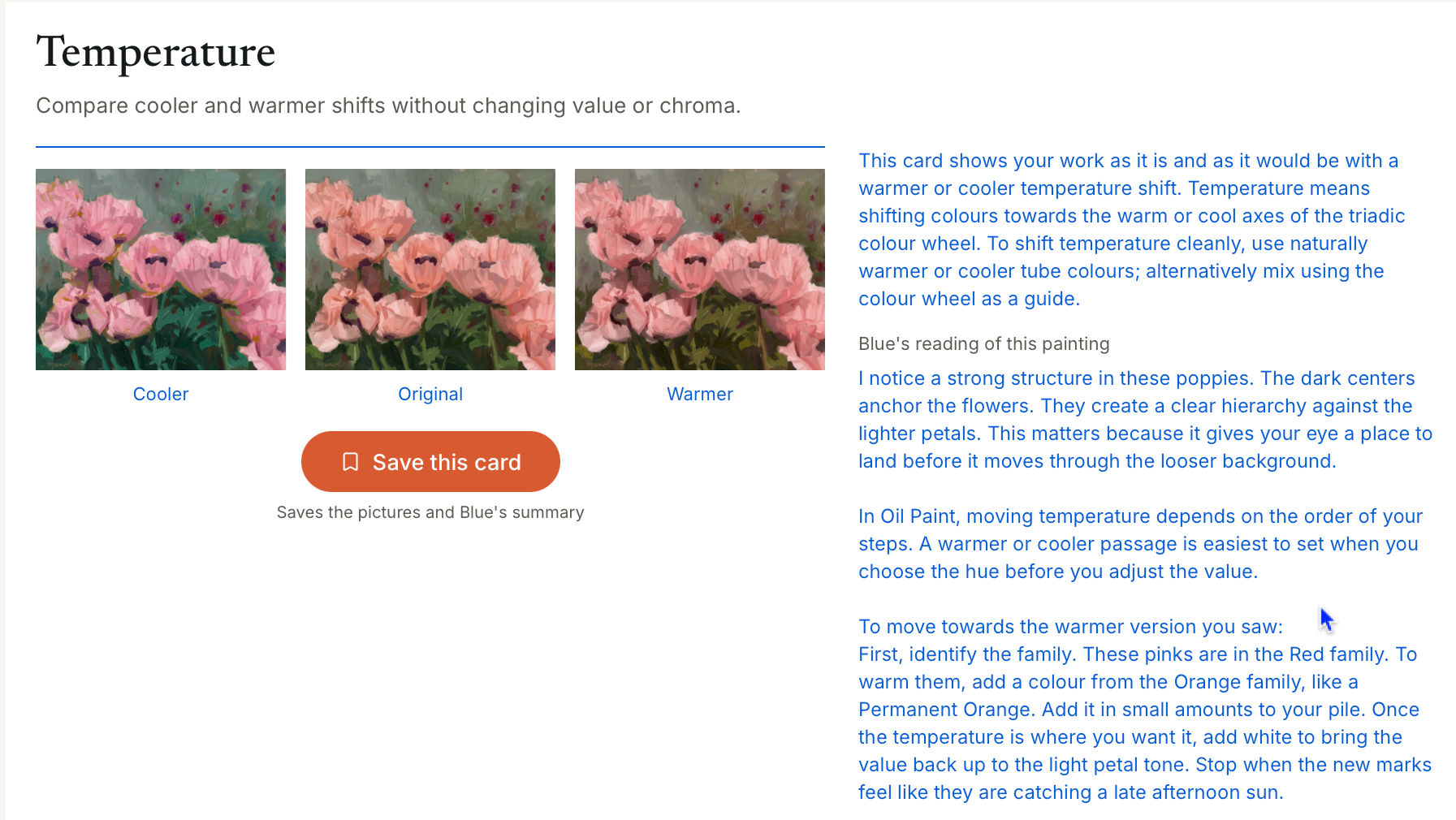
Wrong is a problematic concept in painting. None of these colour temperature options is better or worse than another, but any of them might be ‘wrong’ for the set up a painter has chosen, or become wrong as it develops . Painting is a series of weighted decisions.
Why ZincBlue Is Recursive
Most digital learning tools are built around a linear exchange: a question is asked, an answer is given, and the next question begins more or less afresh. The model is efficient, but it sits uneasily with the way a painting actually develops. Painting is recursive, in that each decision alters the conditions under which the next one is made. A change to the value structure reshapes the colour relationships. A change of palette shifts the balance of temperature. A strengthened edge can make a neighbouring one suddenly feel too assertive. What seemed the right solution ten minutes earlier may no longer be right once the painting has moved on. Any account of teaching that overlooks this is, I think, describing a different activity from the one taking place at the easel.
It is this recognition, more than any technical ambition, that lies at the heart of ZincBlue.
The painting as continuing context
When ZincBlue produces a painting plan, a critique or a Lab analysis, it is not meant to be a static report, read once and set aside. It becomes part of the continuing context of the project. ZincBlue holds the reference you are working from, the medium you have chosen, the direction you hope the painting will take, and the observations already made about it. As the work proceeds, you can question any stage, ask for more detail, change your mind or pursue a particular problem in more depth, and the next answer does not have to begin from nothing. It builds on what has already been established. The difference may appear modest, but its implications for teaching are considerable.
A short example makes the point. Suppose ZincBlue suggests establishing the major value masses before developing colour, and you ask how dark the shadow mass ought to be. The answer can be given in relation to this painting rather than to painting in general. If you then ask whether that shadow could be mixed from ultramarine and burnt sienna rather than black, the conversation moves into colour mixing while still carrying the value problem that prompted the question. And if you decide at that point that you would like the finished work to feel warmer, that decision may reasonably alter the recommended mixture, the handling of the lights, and perhaps the palette proposed for later stages. Each question reshapes the one that follows, so the advice develops with the painting rather than standing outside it. This is what I mean by recursion.
The Labs as ways of looking
ZincBlue's Painting Labs extend the same principle. A Value Lab is not a generic lesson on value but a sustained enquiry into the value structure of a particular painting. A Colour Lab is less a colour wheel than an examination of the relationships actually present in the work, with help in deciding what to do about them. The same holds for the Labs on palette, temperature, saturation, grisaille and blocking-in. Each can open onto a conversation about the work in hand, in which the painter asks why a relationship looks wrong, how it might be altered, and what mixture would achieve the change using the colours already on the palette. Where the answer shifts the direction of the painting, that information can feed back into the wider project. The Labs are therefore better understood not as utilities attached to the side of ZincBlue, but as different ways of looking closely at the same painting.
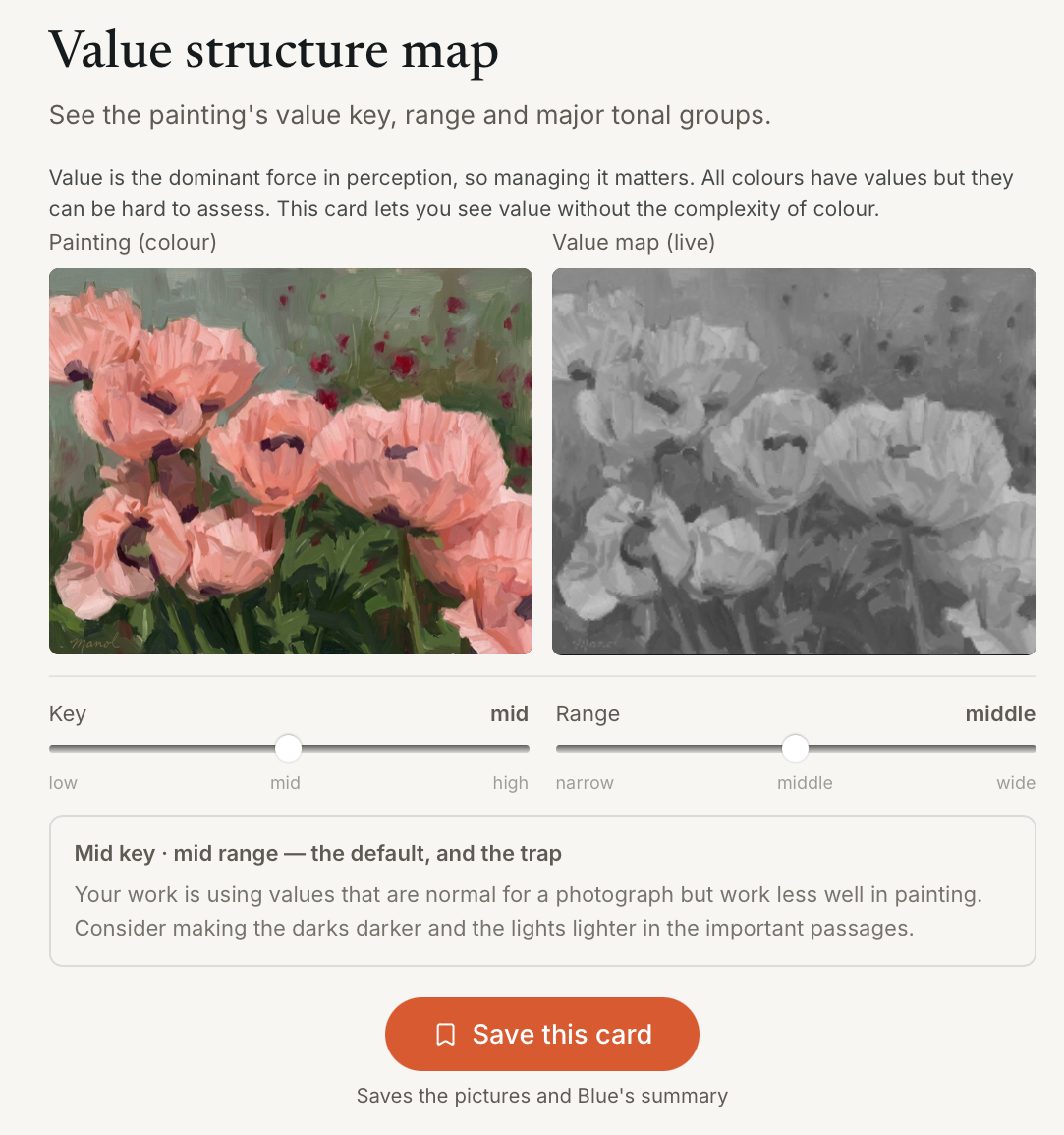
Value is a great exanmple of where ZincBlue can make very important but very un-intuitive things, easy to visalise. Even experienced painters find it hsard to visualise the effect of value changes on colour leed compositions.
Why this matters for painters
Conventional online courses must, of necessity, anticipate problems before the student meets them. A lesson on colour exists because colour is generally useful, and a lesson on value because value is generally useful. The burden then falls on the student to decide which piece of general knowledge applies to the very specific painting in front of them. ZincBlue attempts to reverse that relationship: the painting generates the question, the question shapes the teaching, and the answer becomes part of the context for whatever follows.
This is, I would suggest, much closer to what happens in a good studio tutorial. A tutor does not usually arrive with a prepared lecture and leave once it is delivered. They look at the work, respond to what is happening in it, offer a suggestion, observe what that suggestion reveals, and respond again. Donald Schön described professional practice of this kind as a reflective conversation with the situation, in which the situation answers back and the practitioner adjusts in turn. Teaching of this kind evolves because the painting evolves, and that is the quality ZincBlue's recursive engine is designed to support.
A developing route rather than a recipe
For the same reason, I am cautious about describing ZincBlue simply as a tool that gives painters answers. Painting is seldom improved by putting instruction in place of judgement. The more interesting possibility is that judgement might become easier to exercise. ZincBlue can propose a route, explain why it might work and help to carry it out, but the painter remains free to question that route, reject part of it, change direction or ask for alternatives, and the system then works with the new decision. The process is less a sequence of analysis, prescription and completion than a loop: looking, suggesting, trying, reconsidering and refining, then looking again. That loop can continue for as long as it remains useful.
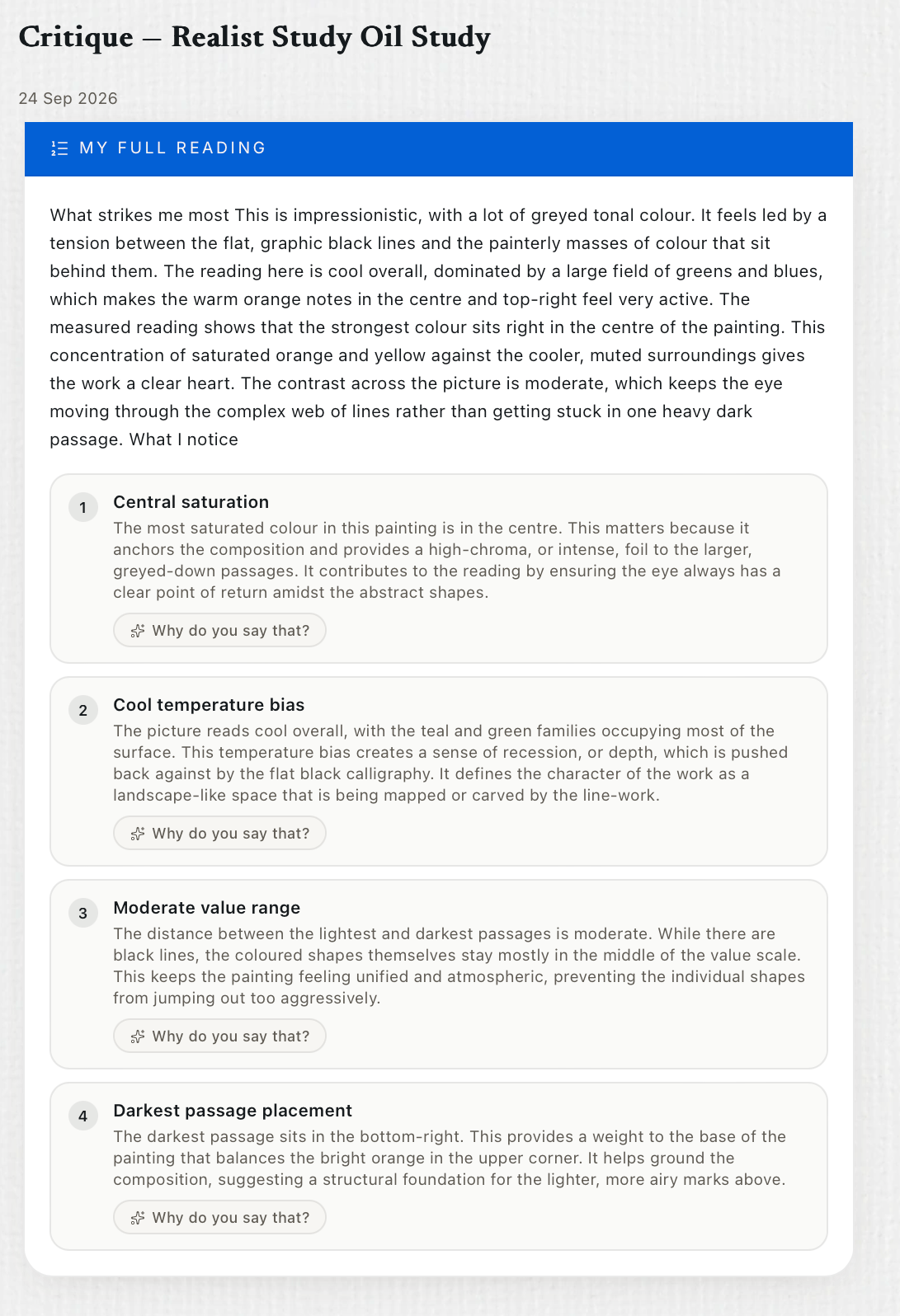
Each of the steps here is relative to the other - so each has a built in chat so users can discuss how it works and is working
Technology in the service of painting
The purpose of ZincBlue, then, is not to automate painting but to make the act of painting better informed. The technology sits behind the studio process. It helps the painter see relationships more clearly, anticipate the likely consequences of a decision, and turn broad advice into something practical enough to use at the easel. The painting and the decisions remain the painter's own. Because each of those decisions becomes part of a continuing conversation, however, ZincBlue can develop alongside the work rather than repeatedly starting over. That recursive structure may in time prove to be among the most important features of the platform, not because recursion is technically clever, but because painting itself is recursive.