
Working with Zinc: From Inspiration to a Painting Plan
Welcome to a detailed preview of some of the studio planning features that the Zinc engine can bring to make your painting time more rewarding, educative and sucessful.
From photo to inspiring painting reference: How ZincBlue helps painters spend time well in the studio.
Working with Zinc begins in much the same way that most paintings begin, which is to say with something that has caught your attention and will not quite let go of it. It might be a photograph you have taken, an image you have found and saved without knowing why, a drawing made quickly in front of the subject, a piece of visual research gathered for another purpose entirely, or a painting already underway on the easel that is not doing what you hoped it would do.
From there, the work can travel in one of two directions. You can bring Zinc a painting you would like help thinking through, or you can begin with a reference that you want to turn into a painting. For this walkthrough I want to concentrate on the second route, partly because it is where most painters begin, and partly because it is where a surprising number of the difficulties begin as well.
Painters collect images constantly, and we do it with a kind of appetite that rarely pauses to interrogate itself. We recognise something in an image that excites us, but recognition of that sort is not the same as knowing what the painting should be. A photograph can be genuinely compelling and still make a disappointing painting, and the reason is worth stating carefully, because it is structural rather than a matter of taste.
A camera and a painter do not record the same world. The camera fixes a moment into a particular frame at a particular focal length, resolves the whole field with more or less equal descriptive authority, compresses a vast range of luminance into a narrow and fairly arbitrary tonal scale, and hands back far more information than a painting has any use for. What it cannot record is the hierarchy of attention that a painter brings to a subject: the way the eye settles, wanders, returns, ignores whole regions of a scene and dwells on a passage of light for no reason it can immediately articulate. The photograph is a description. The painting is an argument about what mattered.
Painting has far greater freedom than description allows. We can compress, exaggerate, simplify, heighten, suppress, reorganise and invent. We can make colour carry more emotional weight than local accuracy would permit, allow one area to dissolve while another becomes emphatic, shift the temperature of an entire scene, or alter the balance of light and dark until the subject begins to feel like a different proposition altogether. Every one of those moves is a decision, and decisions are precisely the thing a reference cannot make for you.
So the more useful aim is not to ask Zinc to reproduce a reference, but to use it to help you re-see what you already have.
For this blog have chosen the kind of ‘great photo - bad reference’ that many amateur painters get unstuck attempting, a charming photograph of a young couple. Although Zinc was made to analyse Modern and Contemporary artworks as part of my doctoral research, I strongly feel that the act of painting should be democatised. If people are inspired to paint because their son or daughter has a photo of their wedding, then well and good .The act of painting is the point of painting, and Zinc is intended to make it easier for people to paint what they want in a style they like. Clement Greenberg would hate it . I do not, if the internet has taught us anything it is that taste can and should be democratised.
Beginning with composition
The first stage is to decide what sort of painting the reference might become, and that begins with format.
You choose the canvas proportion and orientation that suit the painting you have in mind, and then crop the source image accordingly. Described in that way it sounds like an administrative step, but it is usually the first genuinely creative intervention of the whole process, because altering the format alters every relationship inside the image simultaneously. Proportion is not a container that the subject sits inside. It is an active participant in how the subject reads.
A figure that feels lost and incidental in a photograph can become imposing when the frame tightens around it. A landscape may become markedly calmer when space is allowed to open above and around the subject. Something apparently trivial at the edge of an image, a doorway, a shadow, a strip of sky, may turn out to be the element that organises the entire composition once the crop is shifted to include it. These are not effects you can reliably predict by reasoning about them in advance. You find them by trying the framing out.
At this point Zinc is not telling you what the composition should be, and it is important to be clear about that, because the distinction between a tool that proposes and a tool that decides is the distinction on which the whole system rests. You are trying things, looking at them, responding and deciding. What Zinc contributes is speed and visibility: it makes those possibilities easier to see and easier to test before you commit yourself to them in paint, at a stage where commitment is still cheap.
Sometimes that is all you need. You arrive at a crop that feels right, the image already contains what the painting requires, and you can move directly into planning how to make it.
At other times the reference continues to feel as though it contains the beginnings of a painting rather than the painting itself. It is interesting, but it has not yet become an intention. In our test case the image was well composed, but not well balanced thanks to a hugely overexposed background. . Was it possible to retain the composition but reduce background intensity, shifting attention to the couple? That is the point at which the Visualising Bench earns its place.
Seeing what else the image might become
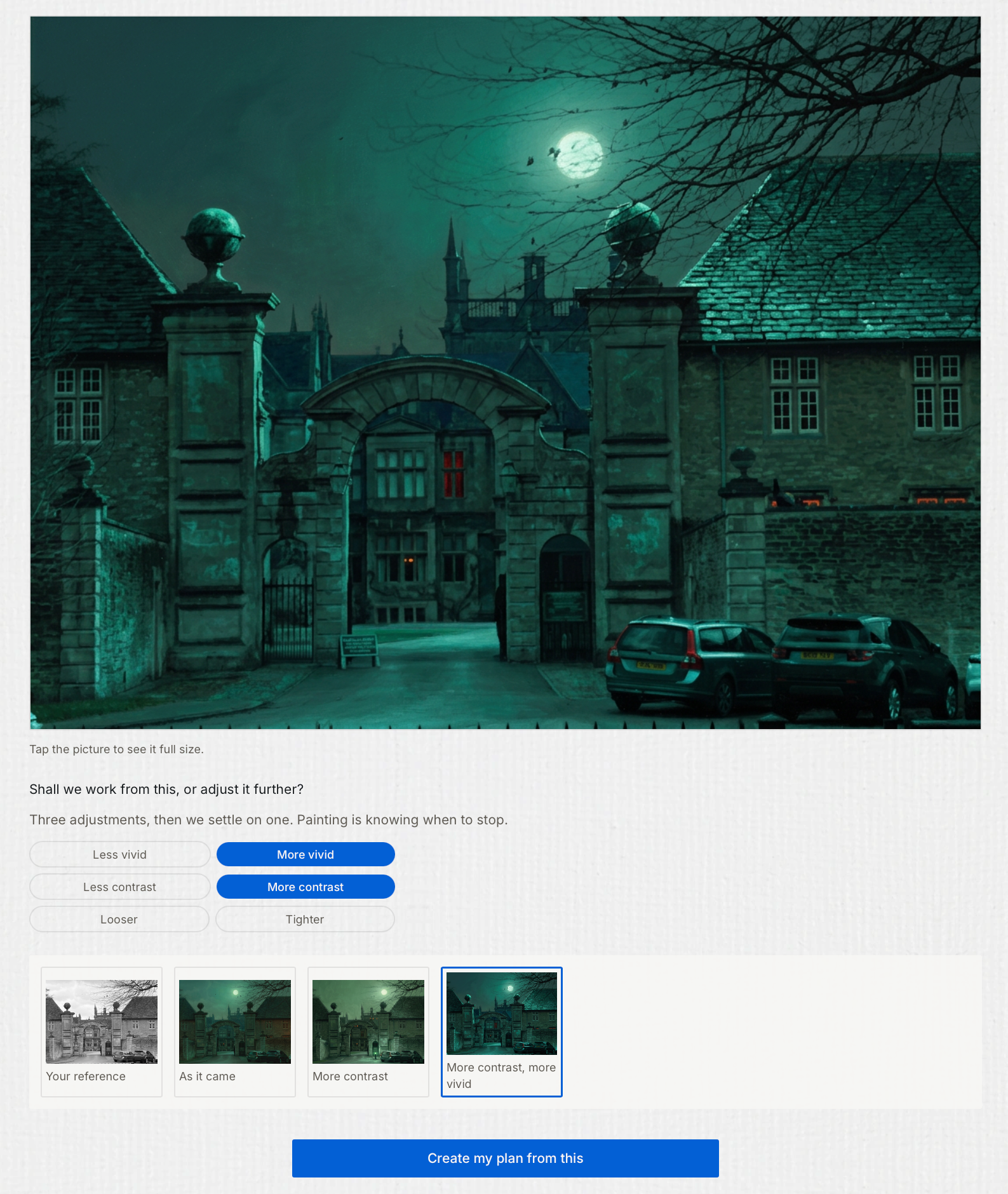
Would a moonlit background make the image more sublime?
Zinc measures images and can cross visualise aesthetic choices withour creating hallucination or AI slop - your image remains your image.
Exploring the Visualising Bench
The Visualising Bench allows you to set another image alongside your reference and use it as a source of visual ideas rather than as a model to be copied.
That second image might be a painting whose colour you have always admired, a photograph with extraordinary light, a work with a particular sense of drama or restraint, a composition whose stillness appeals to you, or simply an image possessing some quality you cannot yet put into words but return to repeatedly.
This matters because painters are very often inspired by things long before they understand why they are inspired by them. You may know with complete confidence that a particular painting feels richer, calmer, stranger, more monumental or more alive than your own reference, and still be unable to say what is producing the effect. That gap between the strength of the response and the weakness of the explanation is one of the quietest obstacles in a painter's development, because you cannot deliberately use a quality you have not yet identified. You can only hope to stumble into it again.
Zinc can help to unpack those relationships and make them nameable.
Perhaps the image you admire relies on a much narrower value range than you assumed, and its apparent luminosity comes from restraint rather than contrast. Perhaps its colour is less naturalistic but considerably more coherent, held together by a family of related mixtures rather than by accuracy. Perhaps the focal point is established by temperature rather than by tonal contrast, which is why the painting feels quiet and emphatic at the same time. Perhaps the background has been simplified so thoroughly that the subject is able to carry a weight it could never have carried in a fully described setting.
Once those qualities become visible and namable, you can begin to explore them in relation to your own image rather than admiring them at a distance.
You might want more colour, or less description, or a greater sense of drama, a cooler overall atmosphere, softer transitions, a more compressed tonal structure, a much stronger separation between subject and surroundings. You might try one of these and know within seconds that it is wrong, which is itself worth knowing. You might equally discover a possibility you would never have arrived at from the original reference alone, because the original reference was quietly limiting the range of paintings you could imagine making from it.
That process of trying, rejecting, adjusting and refining is the substance of the thing, because the creative decision remains yours at every stage. Zinc is helping you to visualise alternatives rather than handing you a finished image and inviting you to follow it. The difference is not merely ethical or rhetorical. A finished image given to a painter tends to shut down enquiry; a set of visible alternatives tends to open it, because each one raises a question about the others.
In that sense it behaves much more like a responsive studio tool than like a generator. You bring the intention and you keep steering, while Zinc makes it easier to see where a decision might lead before you begin committing time, paint and materials to it.
From image to inspirational painting reference
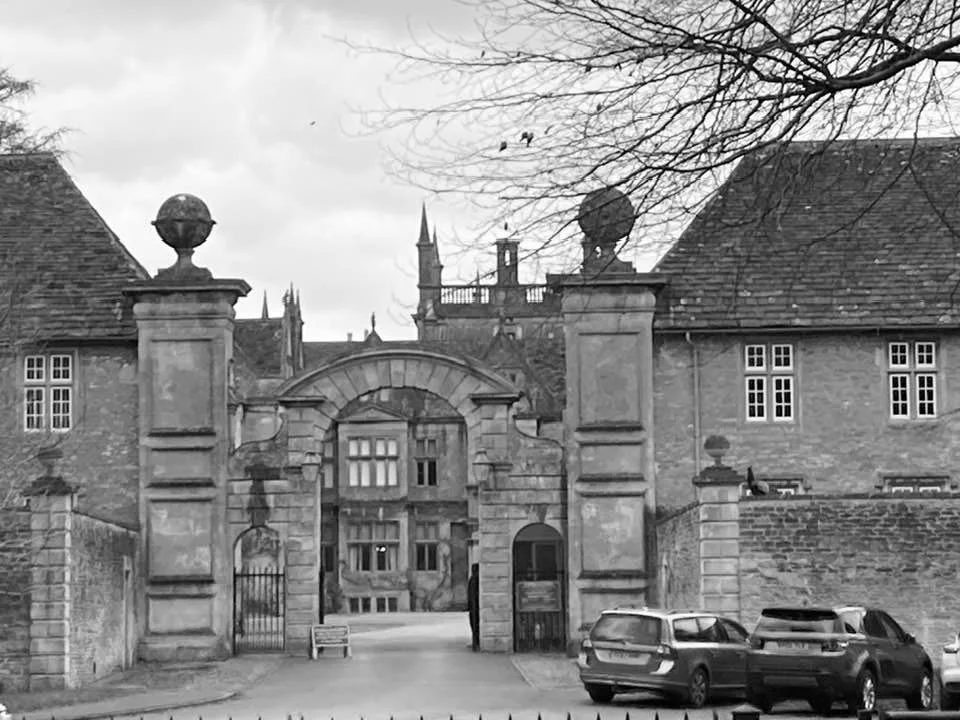
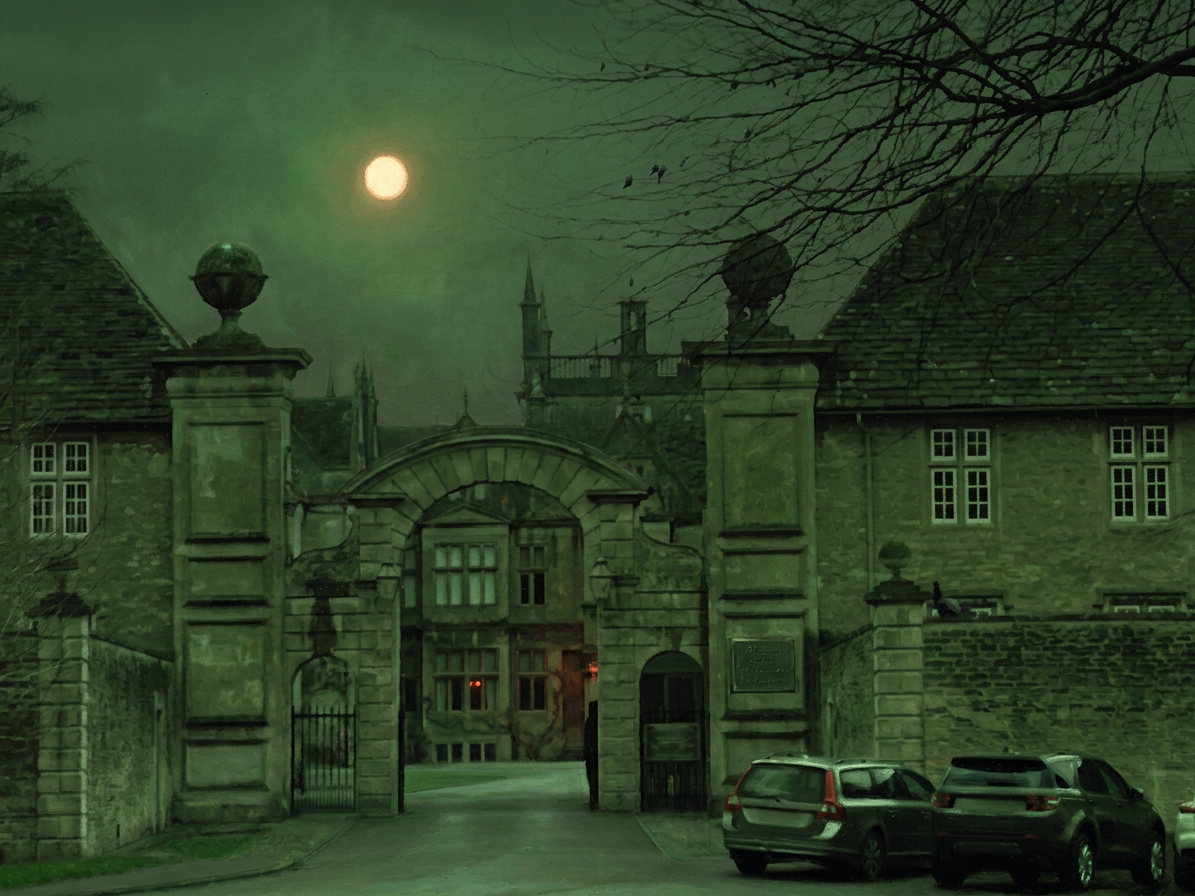
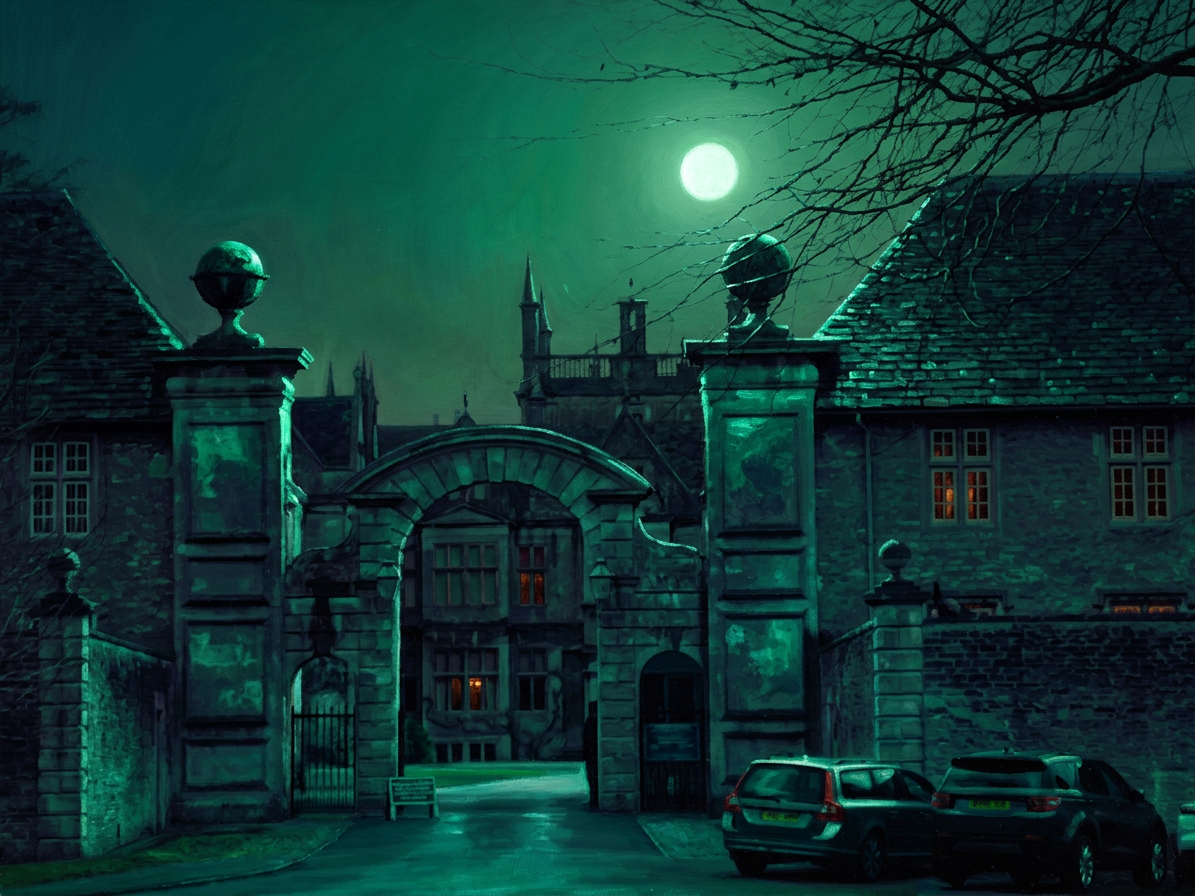
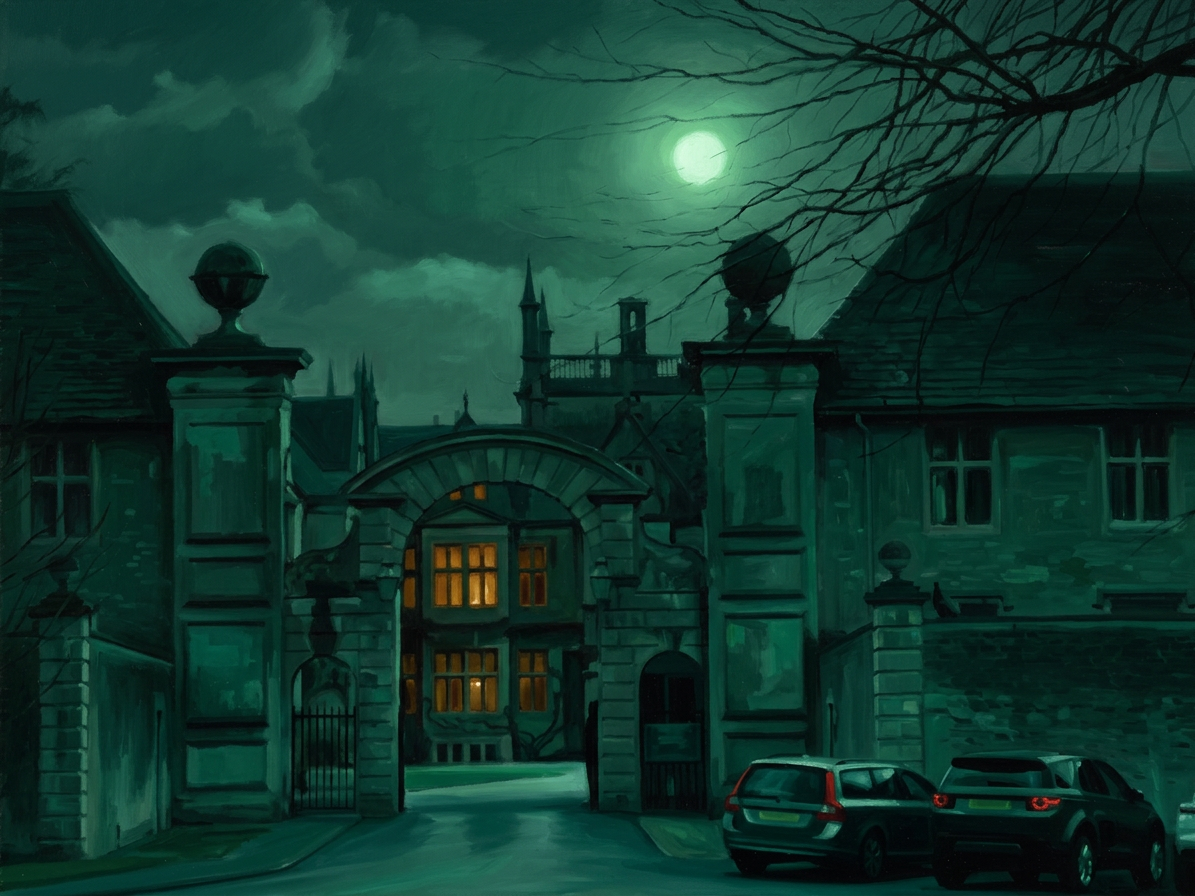
In this example my reference photo has been paired with an image I have after Atkinson Grimshaw. Zinc has created a composite suggestion, and then working with Zinc, I fine tuned it to see how increasing value contrast and then both value & chroma might play out. Any of these can be committed to a full painting plan.
Once the reference has become something you genuinely want to paint, the conversation changes character. It moves from what this could become towards how you might actually make it, and that second question is considerably less glamorous and considerably more consequential.
A painting may be driven by colour, by light, by a particular value structure, by the relationship between figure and ground, or by something much harder to name, such as stillness, tension, intimacy or scale. Identifying that governing intention is the hinge on which a workable plan turns, because every subsequent decision either protects it or erodes it.
This matters most acutely when you are newer to painting, because the difficulty then is rarely a shortage of enthusiasm or even of technical information. The difficulty is not knowing what should happen first, what can safely wait, and what you are actually trying to protect as the painting develops. Sequence is one of the least discussed and most decisive aspects of practice.
If the most important quality in a painting is the light, then the order of working should be arranged to preserve it, which may mean establishing the light logic early and refusing to disturb it later even when a passage seems to invite refinement. If the painting depends on a narrow range of values, there is little point in introducing contrast everywhere simply because the reference happens to contain it; the reference is not the authority, the intention is. If colour is carrying the mood, then the ground, the palette and the mixing strategy may all need to support that from the very first session, because a ground chosen carelessly will keep asserting itself through every subsequent layer.
The plan therefore grows out of the painting you have chosen to make, rather than from a generic sequence that assumes every painter should work in the same way on every subject. Generic sequences are useful as scaffolding for beginners and increasingly obstructive after that, because the moment your intention becomes specific, the default procedure starts working against you.
Because Zinc remains available throughout, the plan stays open to interrogation. You can ask why a particular ground might help, how a colour could be mixed from what you actually have on the palette, whether a passage should be established early or deliberately left until later, how to keep an area loose when your instinct is to tighten it, how to lower saturation without deadening the colour, or why a focal point might need more value contrast than the rest of the painting when everything else has been suppressed.
That is the point at which the system starts to behave less like a set of instructions and more like a form of mentoring, and the distinction rests on purpose. The aim is not simply to get you through one painting to an acceptable conclusion. It is to help you understand why one decision leads to another, so that progressively more of those decisions become yours to make with confidence and without prompting.
Rather than practising an exercise in isolation and hoping that its lesson will transfer to your own work at some unspecified later date, you are learning about value, colour, composition, temperature, mixing and sequencing through the painting you actually wanted to make in the first place. Transfer of learning is notoriously unreliable in the arts, and a good deal of well-intentioned tuition fails precisely at that join. Learning inside the work you care about is slower to set up and far more likely to stick.
Working iteratively
Once the painting is underway, the useful questions become much more specific, and they arrive in response to what is on the surface rather than to what was imagined at the outset.
Perhaps the colours are drifting steadily towards greyness in a way you did not intend and cannot quite locate. Perhaps the whole painting feels cooler than you meant it to be. Perhaps the values looked entirely convincing in the reference and feel too evenly distributed once translated into paint, which is one of the most common and least obvious translation failures in working from photographs. Perhaps the focal point needs more distinction, or, just as plausibly, considerably less.
At that point there is rarely one correct answer, and it is worth resisting the wish for one. Painting develops through a chain of judgements, each made in response to the state of the surface at that moment, and each altering the conditions for the judgement that follows. Zinc is most useful when it becomes part of that same iterative rhythm rather than standing outside it as an oracle.
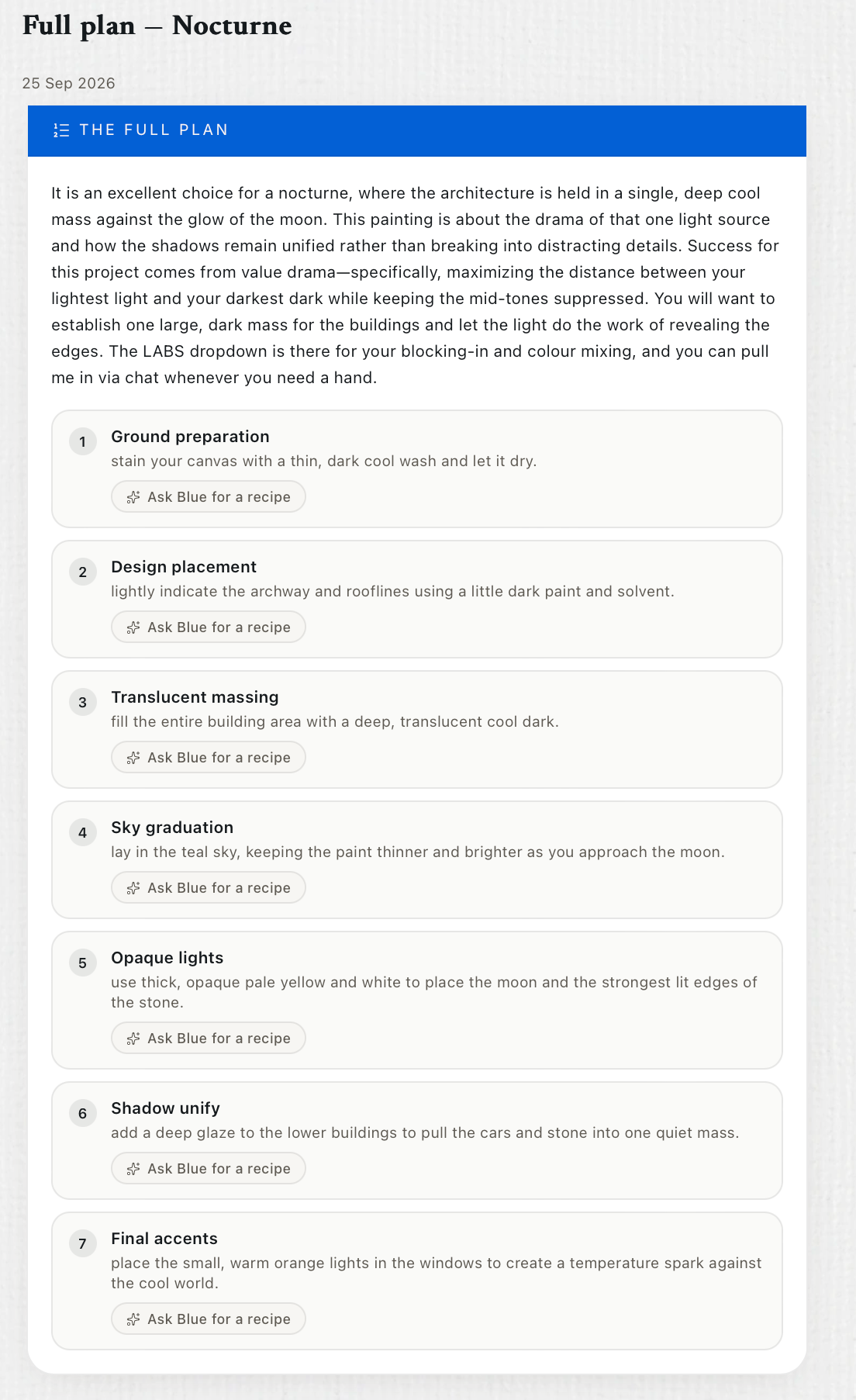
Painting is an Art, but Its also a craft. The difference between success and frustration is rarely lack of skill as much as having a plan to use the skills you have.
You might explore a warmer version and then decide that the cooler one carries more atmosphere after all. You might strengthen the contrast and discover that the painting immediately becomes illustrative in a way you dislike, which tells you something durable about your own preferences. You might reduce saturation overall and realise that a single small area of intense colour is doing more work than a dozen stronger passages ever managed.
The point is not to arrive at a polished answer in one move. It is to be able to test a possibility, see what changes, understand why it changes, and then carry that understanding back to the easel, where it has to survive contact with actual paint.
Seen this way, Zinc is not a shortcut around painting. It is a way of making the act of painting more deliberate, which is a different proposition entirely and a slower one in the short term. The technology sits behind the process rather than replacing any part of it, allowing you to see alternatives quickly enough that more of your studio time is spent making meaningful decisions, and less of it spent discovering several hours and half a canvas later that the effect you were reaching for had already been undermined by a choice made in the first twenty minutes.
Zinc can save time, then, but not by making painting easier in any superficial sense, and any claim to the contrary should be treated with suspicion. It saves time by helping your effort pay.
Making your effort pay
There is an enormous quantity of painting information available online, a great deal of it free and some of it genuinely excellent. Access is no longer the constraint it was a generation ago. The constraint now is relevance: knowing which piece of information applies to the particular painting sitting in front of you, on this surface, in this medium, with this intention.
A painter can spend an entire evening moving through videos on colour mixing, glazing, coloured grounds, value structure and compositional design, and finish the evening no closer to knowing what any of it means for the canvas in the studio. The information was sound. The problem was that none of it was addressed to your situation, and the work of translating general advice into a specific case is exactly the work that requires judgement you may not yet have.
Free information, in that sense, is not the same thing as free learning. You still have to locate the right advice among a great deal of competing and sometimes contradictory material, decide whether it applies to what you are doing, translate it into your own working method, and then find out through trial and error whether it actually helps. That search costs time, and it also costs paint, surfaces, energy and morale, particularly when you keep arriving at the same difficulty without ever quite understanding what produced it.
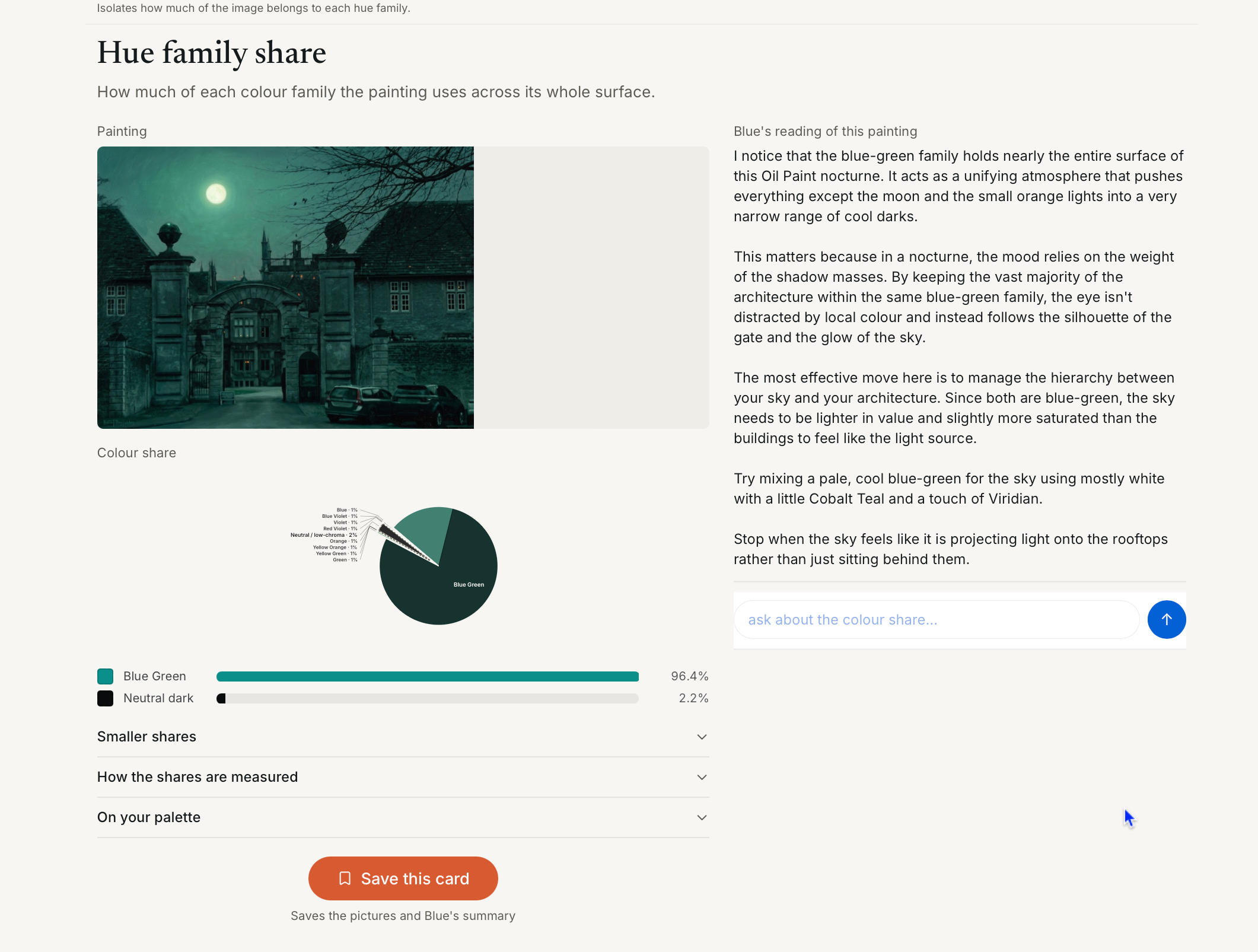
There are thousands of free colour resources online. None of them are about your painting . ZincBlue makes sense of it so you can learn about colour by using it well in your work, not just seeing it work for others.
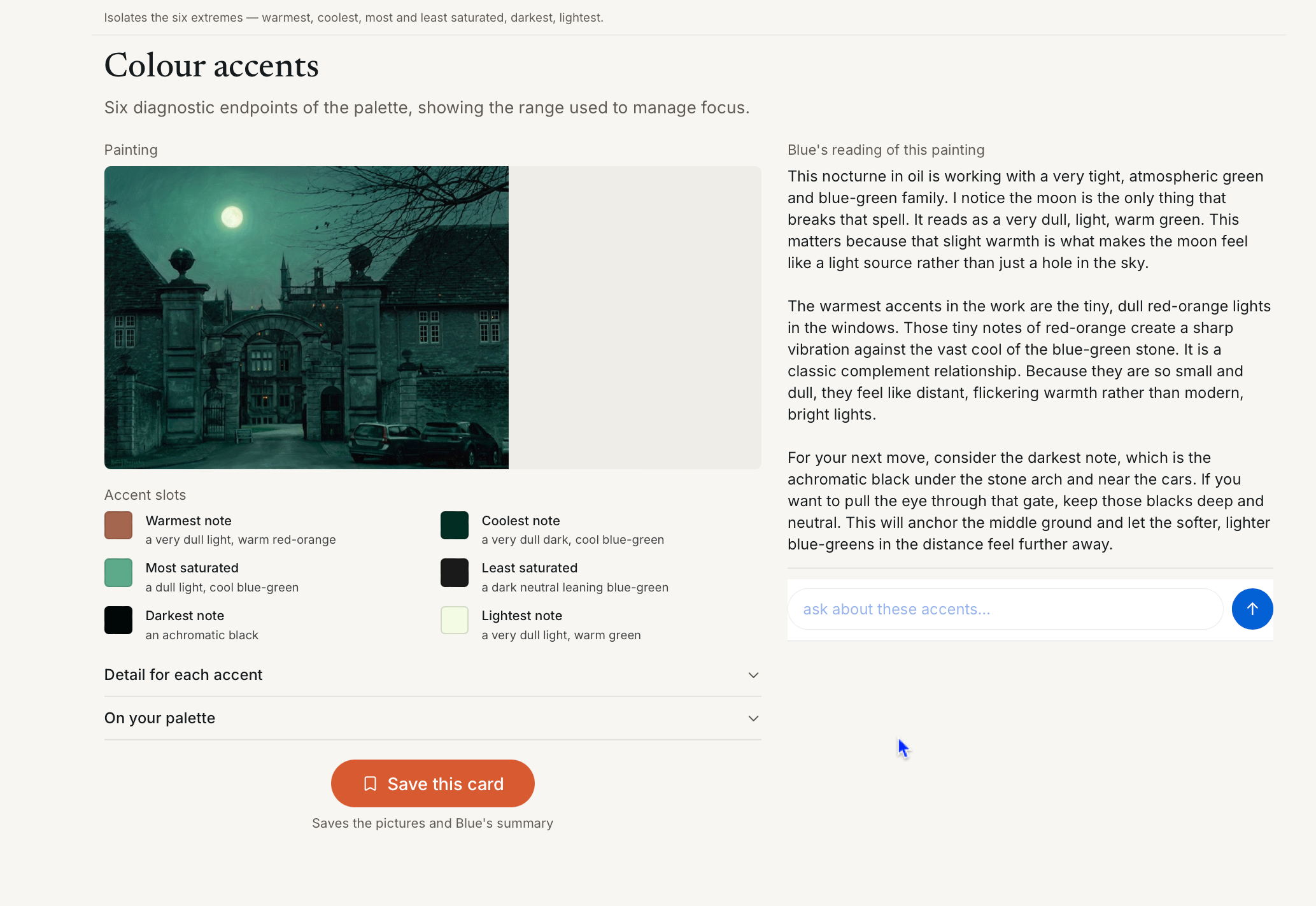
Adding this Accent Analysis completes the colour planning, with useful observations about the amount of each colour, its role and placement.
ZincBlue is designed to work more like bespoke painting tuition or mentoring, because it begins with your work rather than with a library of lessons arranged by topic.
The comparison bears examining in plain terms. Professional one-to-one painting tuition in the UK commonly runs somewhere in the region of sixty to a hundred pounds an hour, and specialist mentoring often sits nearer eighty to a hundred and fifty. What that fee buys is not primarily access to information, since most of the underlying information is freely available elsewhere. It buys the attention of someone experienced enough to look at what you are doing, infer where you are trying to go, and help you decide what would be useful next. It buys diagnosis, in other words, and diagnosis has always been the scarce and expensive part of teaching.
That is the part of teaching ZincBlue is attempting to make available in a different form and at a different scale. Instead of searching for a generic lesson on colour, you can think about the colour in the painting you are actually making. Instead of watching someone else demonstrate their blocking-in method and trying to work out how much of it transfers, you can explore a blocking-in strategy built around your own image, your own materials and your own intention.
The saving is therefore not simply financial, and framing it as a subscription set against an hourly rate rather misses what is happening. It is the accumulated saving that comes from fewer dead ends, fewer unnecessary experiments, and fewer occasions on which a great deal of effort turns out to have been spent solving the wrong problem with real skill.
Experiments will still fail, and they should. Failure in the studio is not a defect in the process; it is a large part of how the process works, and any system promising to eliminate it would be promising something both undeliverable and undesirable. The aim is not to remove uncertainty from painting. It is to make uncertainty more productive, by helping you understand what you are testing, why you are testing it, and what the result actually tells you.
A project that grows with the painting
As the work develops, the original plan can and usually should change with it.
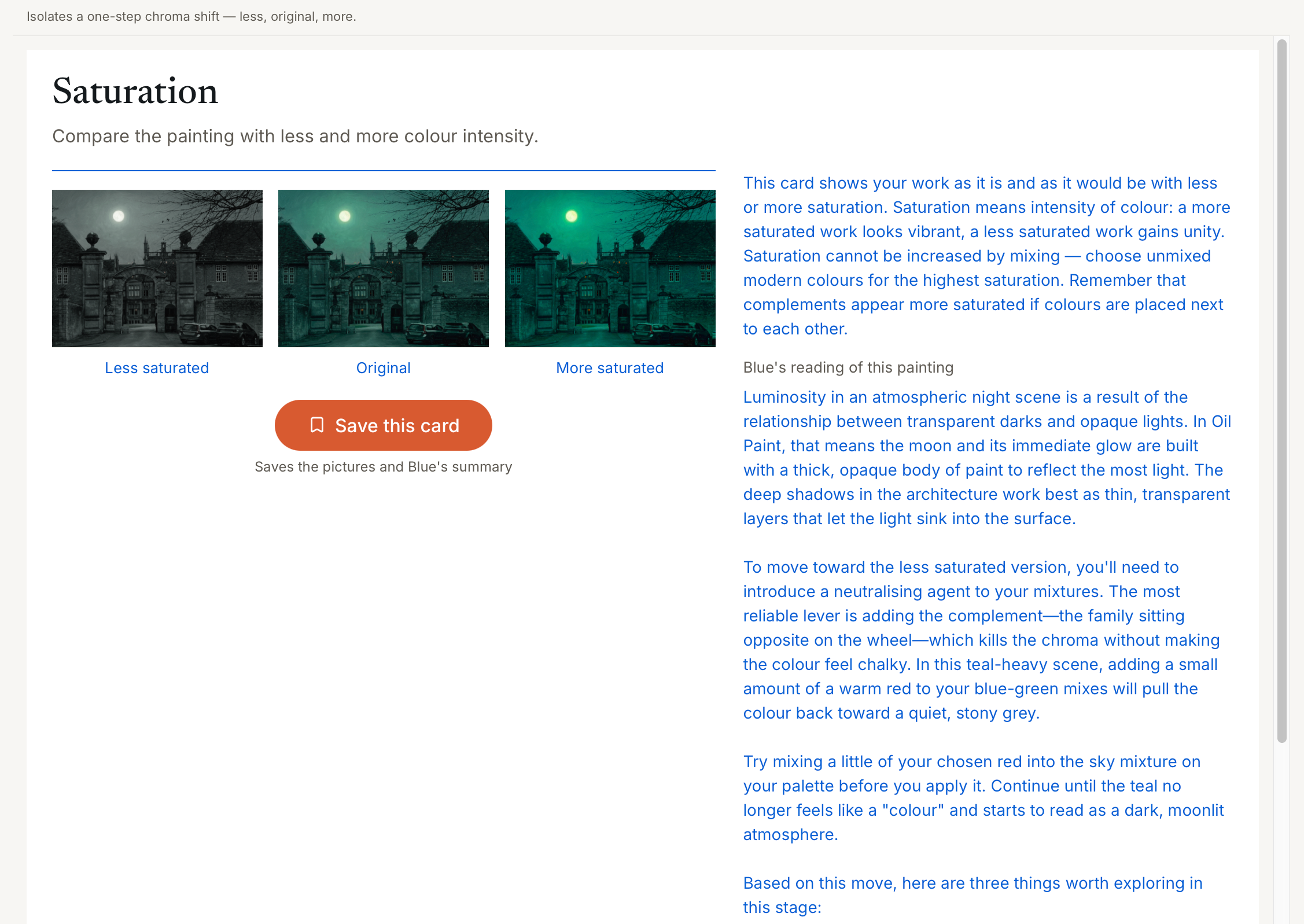
Visualising big decisions
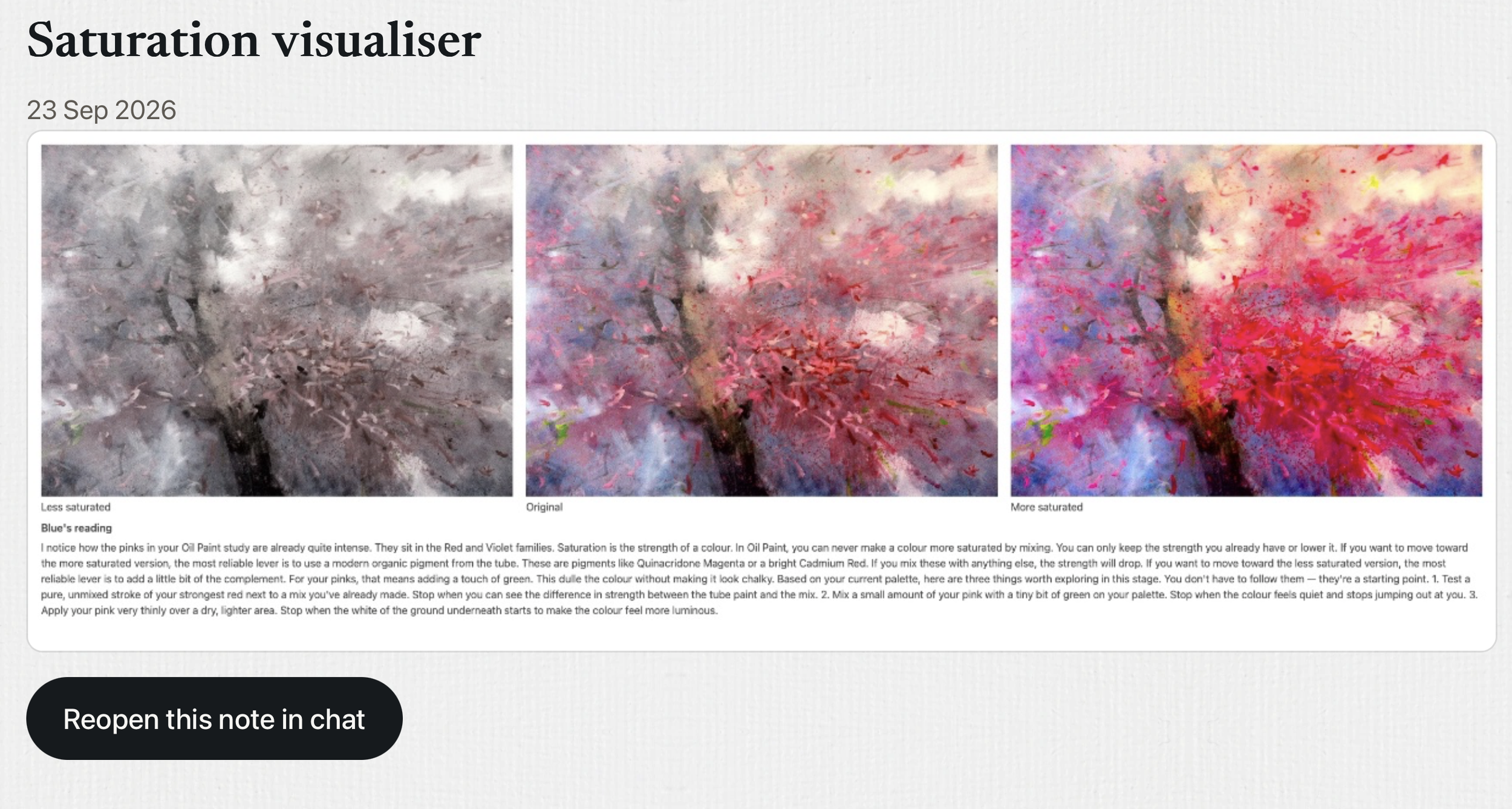
All paintings are different images made using the same tools. Visualising a change of saturation in this painting plan is a great way to work with ZincBlue.
A painting frequently reveals something halfway through that nobody could have predicted at the outset. A colour relationship becomes more interesting than the subject that was supposed to justify it. A passage intended as secondary quietly takes over and starts carrying the whole picture. Something planned with great care turns out not to matter in the least.
Rather than treating the first plan as a contract to be honoured, Zinc allows the project to stay open to those discoveries. You can return to an earlier idea and see whether it now looks better or worse than it did, compare the current state of the painting against the reference, set one stage beside another to see what actually changed between them, or place the work alongside something you admire and ask a more precise question about the distance between them.
Sometimes you will simply want to try a hypothetical before touching the painting again. What would happen if the shadows were warmer, if the dominant red disappeared entirely, if the painting became much flatter in value, if the background carried almost no description at all. You can look at the consequence and then decide whether any part of it belongs in the work, and a clear no is frequently as valuable as an enthusiastic yes, because it closes off a question that might otherwise have cost you a week.
Over time this changes the character of the project itself. What began as a way of preparing a single painting can become a record of how you think about painting: where your decisions tend to succeed, where the same problems recur across different subjects, and which kinds of visual relationship increasingly feel like your own rather than borrowed. Practitioners have always kept sketchbooks and notes for something like this reason, and what accumulates in a Studio Book is a version of the same instinct with the comparisons made legible.
That is why a Zinc project can be very short or unexpectedly deep. You might use it for ten minutes to settle a composition and never open it again, which is a perfectly good use of it. Or you might return to it across weeks of painting, letting the Studio Book accumulate plans, comparisons, colour ideas, unresolved questions and changes of direction until it becomes a document of the thinking as much as of the painting.
Either way the value sits in the same place. It is not in Zinc making choices on your behalf, but in giving you a better environment in which to make those choices yourself.
The technology may make the analysis quicker, the comparisons easier and the possibilities more visible, but the purpose remains thoroughly traditional. You still have to look, judge, mix, place, alter, scrape, repaint and decide when a painting has had enough. Nothing in the system removes any of that, and nothing is intended to.
ZincBlue does not offer a way around the difficult part of painting. It offers a way of making the difficult part more useful, so that each painting leaves you not only with a better piece of work, but with a slightly clearer understanding of how you arrived at it.
An open question worth testing
There is a larger proposition underneath all of this, and it is one I would rather put forward for examination than assert.
The studio tradition has always depended on a particular kind of attention: an experienced eye that could look at your work, understand what you were reaching for, and tell you what to attend to next. The atelier, the apprenticeship and the sustained tutorial relationship all existed to supply it. Most painters working today have limited access to that, not through any failure of will but through cost, geography and time, and the open web has supplied volume in its place rather than attention.
The question worth putting seriously is whether adaptive tools of this kind can carry any meaningful part of that diagnostic function. Not whether they can generate images, which is settled and largely beside the point, but whether they can help a painter become more informed about their own practice: better at identifying what a painting needs, quicker to recognise a recurring weakness, more precise about why a decision worked, and more confident about acting without waiting for permission.
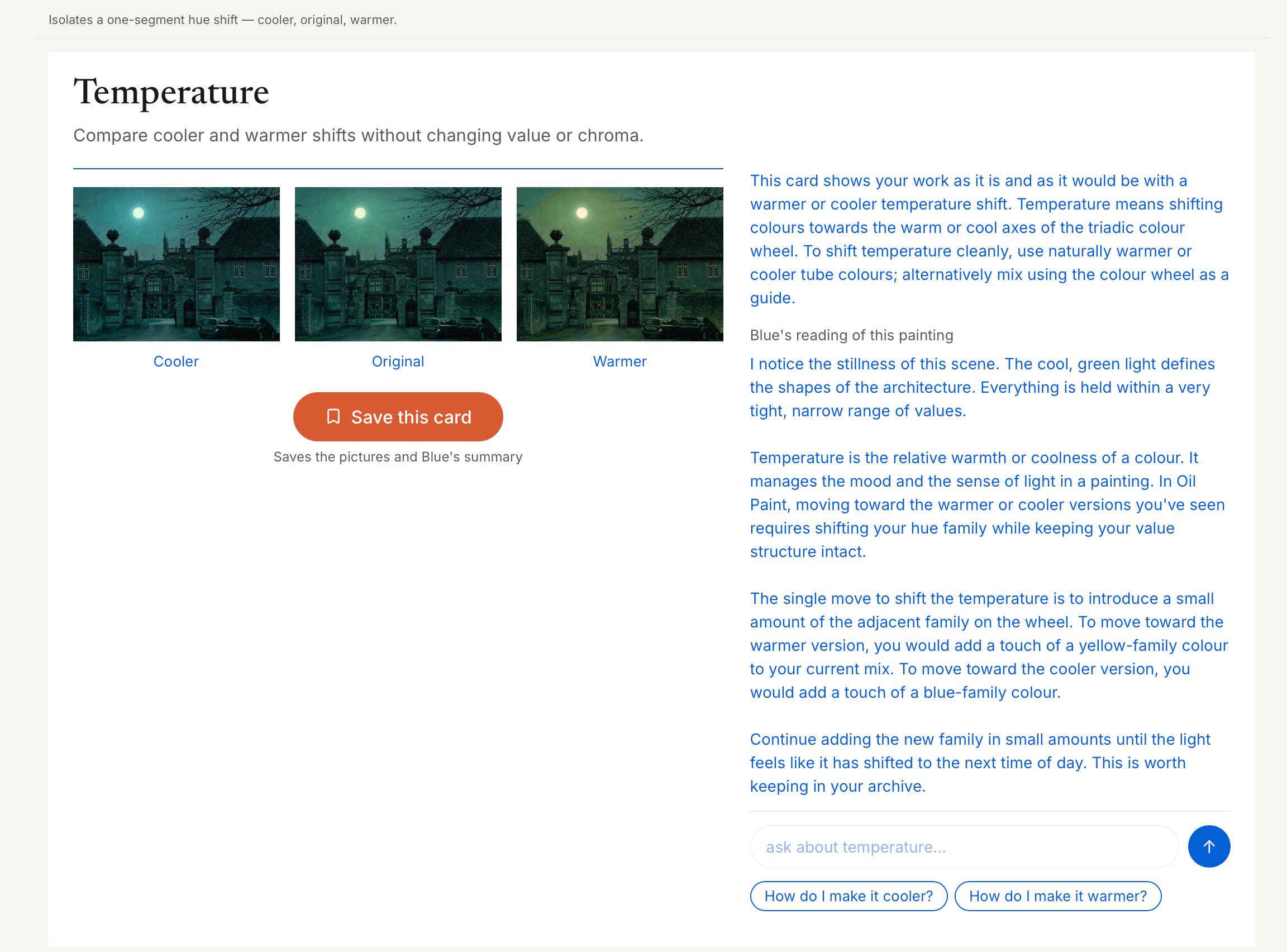
ZincBlue is an experienced eye that can look at your work, understand what you are reaching for, and tell you what to attend to next. It uses 20 years of practical teaching notes to offer ideas about works that just don’t quite work or could work better.
That question cannot be answered by argument alone, and I would not want it to be. It is an empirical matter, and the evidence will come from studios rather than from claims. So the invitation is a practical one. Bring a real painting, one you care about and are slightly stuck on. Use the process properly for the length of that painting, keep some record of what you tried and what you rejected, and then judge the result against the standard that actually matters: not whether the software was impressive, but whether you understood your own decisions more clearly at the end than you did at the beginning, and whether the next painting started from further along.