
ZincBlue - an answer to AI Art.
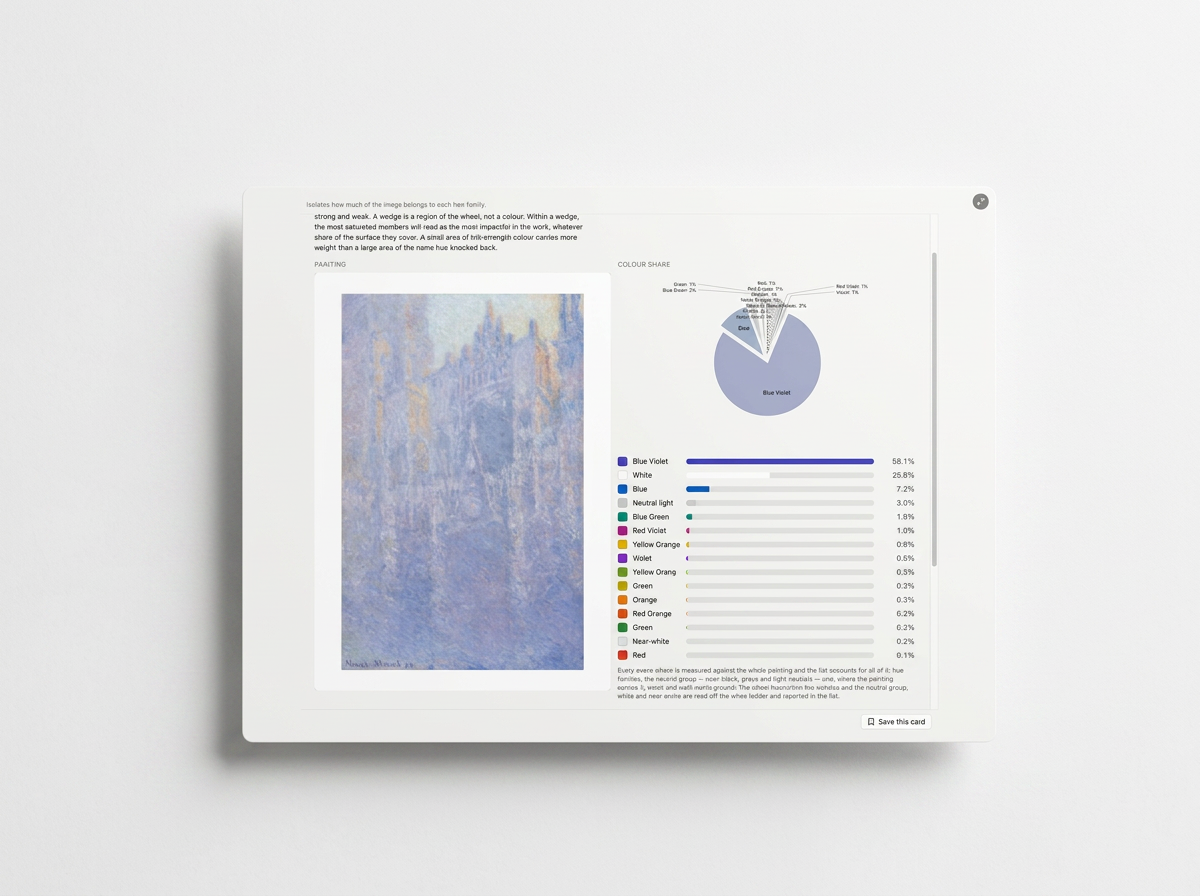
Strong work often has strong colour choices. The ZincBlue Engine makes it easy to see those choices and apply the wide lesson to your work.
AI is not killing art. We have been here before. In the nineteenth century, photography seemed to threaten the very purpose of painting, yet artists did not disappear: they changed the terms of the argument. The question now is much the same. Not whether AI belongs in art, but how artists choose to use it.
As part of my doctoral research, I developed an image analysis system called Zinc, designed to extract complex measurements of colour, value and pictorial structure from paintings. Alongside it, I developed an AI agent called Blue, which translates that data back into painterly language I can actually use. I realised that by combining Zinc’s analysis with Blue and the teaching model I had developed over more than twenty years of working with painters, I could build something interesting: a system that uses AI to turn my measurements into lessons to help painters That engine, now called ZincBlue, has been tested at every stage to ensure that it only uses AI models in this hands - off way. Painters are right to want reassurance on what AI might or might not be doing with images, so here is a summary of my latest pre release audit.
How your work is assesed. A measurement audit. September 2026.
Painters ask a version of the same question we asked in our audit, and it is a fair one: is this thing painting for me, rather than looking at my work ? for readers unfamiliar with the terms , AI in this context is called a ‘model’. this report assesses: 1: if and when models are called (used), and 2: how they are allowed to act when they are.
The short answer is no. ZincBlue does not use models to produce paintings. It produces readings, variations and plans, to let you see what works, why it works, and what could work better, and you produce the painting. But "no" is easy to say, so below is the audit that supports it, with the numbers, and what happens for users who want to engage with elenentads of generative AI but do so in a way that does not relinquish authorship.
1. Scope
The whole application was tested end to end: every module, every reading surface, every route by which data leaves the machine. The question under examination was not in any way constrained or narrow — which parts of ZincBlue contact an AI model, and which parts cannot?
2. Method
Every file was checked for a route out: a call to a model, an API key, a network request to a language or image service. Files were then sorted into those that have one and those that do not. The measurement layer was isolated and examined separately.
3. Finding: 96% of ZincBlue never contacts an AI model
Of the application's source files, only 17 can reach an AI model. 527 cannot. Measured by volume of code the ratio is close to the same: roughly 96% of ZincBlue is deterministic — it computes an answer from data and works from the same data every time it is asked. That data is then used to answer specific questions put to it by the user.
This is a count of code, not of importance, and we would not want it read as more than it is. Its value is in what it rules out. Ninety-six per cent of this application is arithmetic, and arithmetic does not have opinions, moods, hallucinate or offer confident wrong answers.
4. Finding: the measurement core has no route out at all
The parts of ZincBlue that read your painting — the colour engine, the wheel, the mixing logic, the pixel readers, the comparison mathematics — were isolated and examined as a group. Twenty-three thousand lines.Zero calls to any AI model.
It is not that these modules choose not to ask. They deliberately have no mechanism for asking. There is no key, no request, no route. If every AI service on earth went dark this afternoon, every reading ZincBlue makes about your painting would still be produced, correctly, at the same speed.
The colour data underneath it is measured, not remembered: 701 tubes across Gamblin, Winsor & Newton and Michael Harding, in oil, watercolour, acrylic, gouache and water mixable oil, each sampled from the maker's own published charts by a single consistent method.
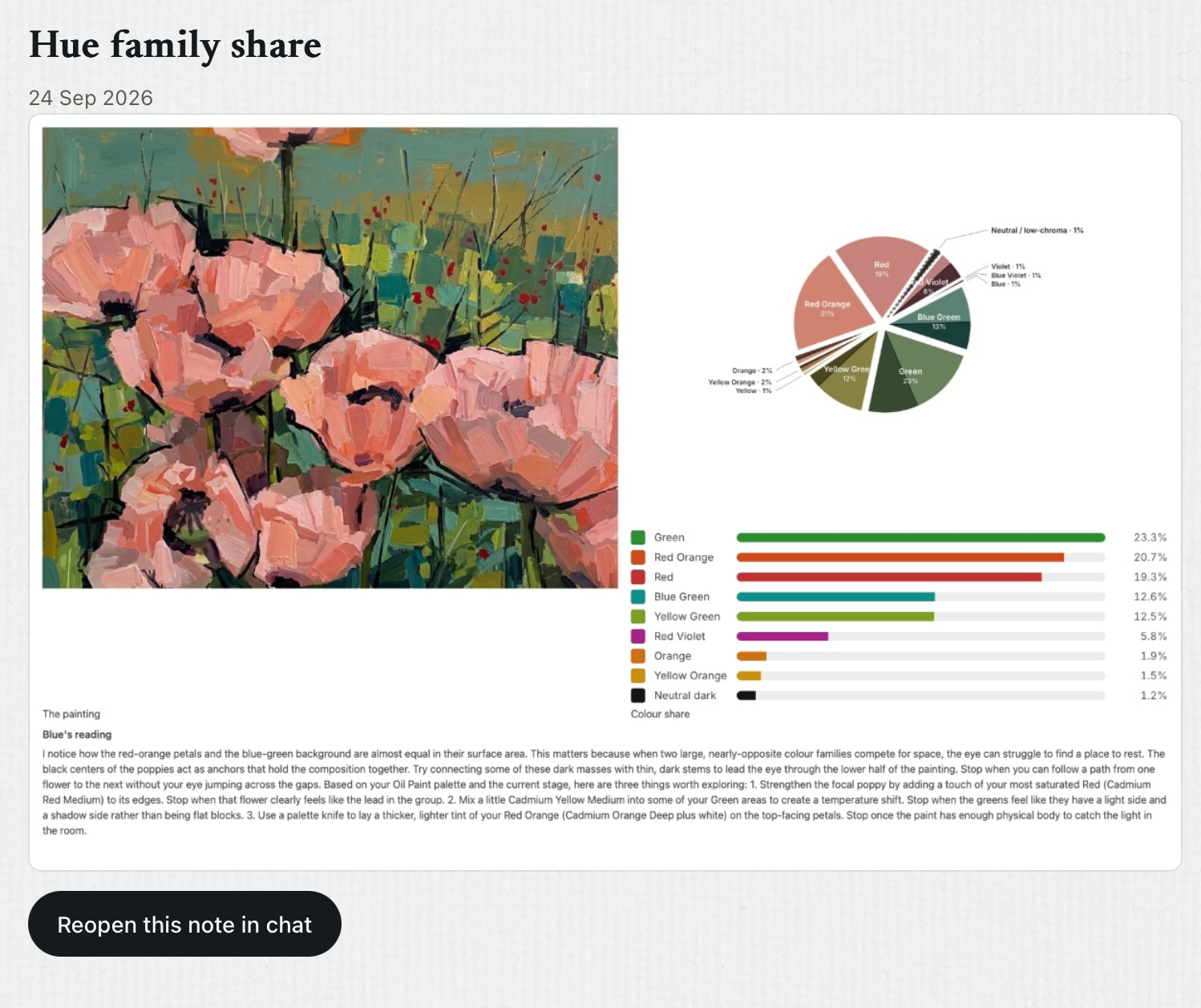
The ZincBlue engine compares your work to over 700 known tube colours in masstone, tint, shade and tone and reports against the palette you tell it you have. Personalised colour tuition using the colours you like to use in oil, watercolour, acrylic or gouache.
5. Finding: what is never sent to an AI model
This is the operative list. None of the following is produced by, checked by, or passed to a model at any point:
What colour a passage in your painting is.
Its value, its temperature, its saturation, its position on the wheel.
Which family a colour belongs to, and which of your tubes will reach it.
What to mix, from which tube, in what order.
Whether your painting matches your reference, by how much, and where.
Where a tube sits, and what happens to it when mixed with another.
Any assessment of whether a painting is good.
Every one of those answers exists before any model is involved, and would exist if none ever were.
6. Finding: what AI is used for
Three things, and none of them replaces user judgement.
It packages the data. A measurement is a number. A number is not a painting lesson. The model's principal job is to take findings that already exist and express them as something a painter can read and act on — turning tonal range 0.42 against reference 0.71 into a sentence about where your darks are giving up. It is a translator working from a text it did not write and cannot alter. AI is programmed to turn complex numerical data into useful findings painters can understand and act upon.
It holds the conversation. When you want to talk something through witgh the chat feature in ZincBlue, that interaction is handled by a model which has been given data about how you have painted the image you are discussiong by the measurement and assessment tools in ZincBlue . It is given the measurements as fact, it is given your opinions by you, and it is not permitted to overrule facts or invent new ones you might want to hear.
At the users discretion it can be instructed at the start of a project to modify a reference to visualise how a stylistic change might play out. This is included for users who would value some structred re-visualisation and is absolutely optional for those who would not. You can run ZincBlue without any AI help, and just use it to translate what is measured into the feedback you would get in live mentoring.
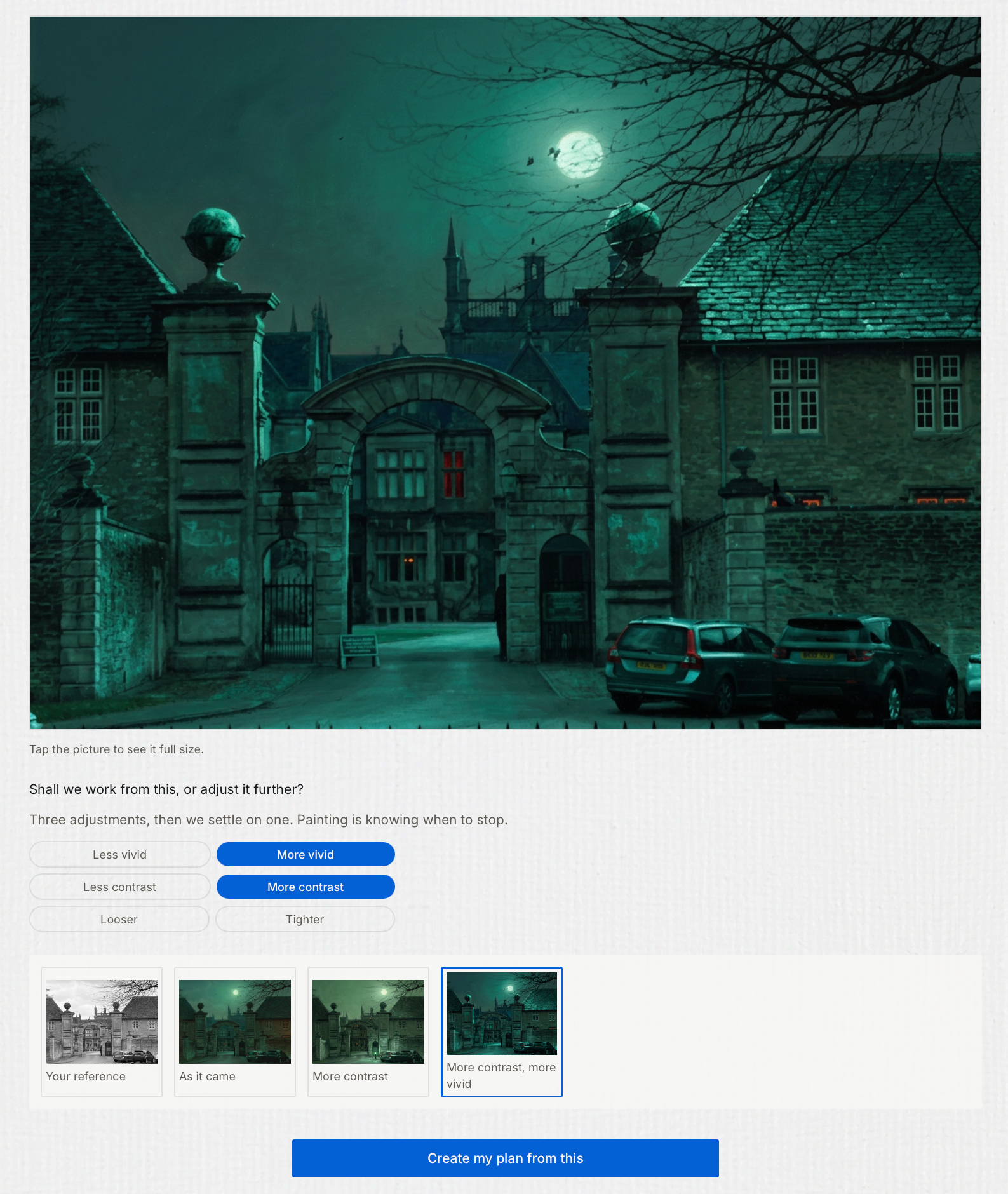
What would happen if? ZincBlue’s optional visualiser can suggest how artistic choices could play out; ideal if you need a little visual inspiration
7. Visualisation, stated plainly
Many painters struggle with visualising how painting in a style would change their reference. My in the studio teaching model understands style as a series of choices which can be visualised, and AI can be used to help you see what those choices could do. When you bring a reference and ask to see what it might become if it were restyled , an hybrid reference is generated, which can be used or ignored. That is a machine augmenting an existing reference, to a possible stylistic direction chosen by you. It is not allowed to make styles up. It is not allowed to invent your starting point., It is not allowed to decide what a stylistic change might do outyside of the data it derives from your reference and gsathers from your stylistic choices.
Three things constrain it, and they are the reason we are comfortable with it.
It is your picture. The instruction is built from a measured reading of the reference you brought — the same objects, the same number of them, in the same places, from the same viewpoint. What changes is colour, value, edge and mark. Nothing is added and nothing is removed.
It is checked. The returned image is measured against your original and the difference computed, to catch the case where the machine has quietly produced a different picture.
It is not a replacement for your reference. The render is a proposal, shown so you can firm up what you are aiming for. What ZincBlue then gives you is a plan for painting it yourself, in your medium, with the tubes you own. You leave with instructions and a direction , not with a finished painting.
8. Conclusion
ZincBlue is not a machine that paints. It is a machine that measures, and creates a mentoring plan for what to do about what it found.
The accurate claim, is not that ZincBlue contains no AI. It is that ZincBlue's measurements are never AI — and that the model is used to make findings readable, never to produce them.
We would rather you were able to check that than take our word for it.
ZincBlue is in private beta. Leave your email and we will tell you when it opens